
History Summer School FAQ
The History Summer School is a serious and demanding course. Over five days, students engage in sustained discussion, close reading and careful argument about historical interpretation. Rather than focusing on covering large amounts of material, the course explores how historians approach evidence, debate competing explanations, and construct accounts of the past.
The questions below explain how the course works in practice, what kind of students tend to enjoy it most, and what to expect if you decide to take part.
Looking for this year’s detailed session breakdown and available dates? Visit the History Summer School course page for the in-person and online events.
Academic Level & Expectations
The course is taught at roughly the level of an introductory undergraduate seminar. Students engage with real historiographical debates, analyse extracts from important historical thinkers, and spend much of their time discussing ideas rather than listening to lectures.
That does not mean prior specialist knowledge is required. Many students will be encountering some of these ideas for the first time. What matters more than background knowledge is curiosity and a willingness to think carefully about difficult questions.
The aim is to give students a genuine experience of what studying history at a high level can feel like: reading closely, testing interpretations, and discovering how the same evidence can support very different arguments.
In many ways, yes. Students are introduced to ideas and debates that are commonly encountered in the early stages of a university history degree. They read short extracts from historians and political thinkers, discuss competing interpretations of historical events, and consider how different intellectual frameworks shape the way history is written.
What tends to surprise students most is the openness of the discussion. At school, historical questions often have fairly clear expectations about what a strong answer looks like. In this course, students are encouraged to explore ideas more freely: weighing evidence, questioning assumptions, and testing different interpretations in conversation with each other.
For many students this is the moment when history begins to feel less like mastering a set narrative and more like participating in an ongoing intellectual conversation.
A-level history is necessarily structured around assessment. Students learn detailed knowledge about particular periods and develop the skills needed to construct strong examination essays.
This course takes a different approach. Instead of focusing on mastering a set syllabus, it explores how historians think: how interpretations are formed, how evidence is used, and why historians often disagree with one another about the same events.
Students encounter ideas and debates that do not have simple answers. They read extracts from historians and political thinkers, discuss competing interpretations, and test their own arguments in conversation with others.
For many students, this is what makes the experience so engaging. Without the pressure of exams, they are free to explore historical questions more openly and discover how rich and intellectually alive the subject can be.
The course is intensive. Over five days, students are introduced to a wide range of ideas and debates that are often encountered in the early stages of a university history degree. In that sense, it is something of a whistle-stop tour through material that students might otherwise spend a term exploring.
That pace can feel both exciting and a little exhausting. Students are reading new ideas, testing interpretations, and engaging in discussion throughout the day. It is not a passive course where you can simply sit back and listen.
Students often comment afterwards that they feel they have learned an extraordinary amount in a very short space of time. Some even say that the week exposed them to more new ideas than they had encountered in a full year of school history. Experiences vary, of course, but for students who engage deeply, the intellectual rewards can be substantial – and many find that it makes the transition to university-style learning feel far less daunting.
As with most intellectually demanding experiences, students tend to get out of the course what they put into it. Those who arrive ready to think actively, ask questions, and take part in discussion usually find the week both challenging and enormously rewarding.
No specific prior knowledge is required. The course is designed so that students can engage fully even if they have not previously studied the topics being discussed. In fact, many of the historical examples and case studies are deliberately chosen because they are unlikely to have been covered in school, which helps ensure that everyone begins on roughly the same footing.
At the same time, many of the students who attend are enthusiastic readers who enjoy exploring history well beyond the school curriculum. That curiosity is very welcome. Students are encouraged to bring their own interests, examples and outside reading into the discussions, and this often enriches the conversations considerably.
Because the course is not tied to a particular syllabus, students have the freedom to range widely across historical ideas and examples. Some of the most interesting moments in discussion arise when someone connects the themes of the course with a book they have read or a historical topic that particularly fascinates them.
The Philosophy of the Course

One of the most interesting things about studying history at a deeper level is discovering that historians do not simply uncover facts about the past. They interpret evidence, ask different kinds of questions, and often disagree about how events should be understood.
Historiography and historical theory help us explore these differences. They introduce students to the ideas and frameworks that historians use when thinking about the past – whether that involves questions of power, culture, economics, identity, or political ideology.
This kind of thinking sits at the heart of serious historical study. Students who go on to study history at university quickly encounter debates about interpretation, perspective, and historical method, so becoming familiar with these ideas early can be extremely valuable.
At the same time, engaging with these ideas often transforms how students see the subject. Once they begin to recognise that historical narratives depend on interpretation and perspective, history becomes far more dynamic: an active process of questioning, debate and discovery rather than a fixed account of what happened.
The goal is not to turn students into specialists in theory, but to give them a glimpse of the intellectual tools historians use when making sense of the past.
One of the aims of the course is to give students the opportunity to experience history as a living intellectual discipline rather than simply a body of knowledge to be mastered for an examination.
When historians study the past seriously, they are constantly asking questions: Why do different historians interpret the same events differently? How do political ideas, cultural assumptions, or moral values shape the stories we tell about the past? What kinds of evidence allow us to challenge those stories?
Approaching history in this way encourages students to think more independently and more critically about the narratives they encounter. Instead of treating historical accounts as fixed or authoritative, they begin to see them as interpretations that can be examined, debated, and sometimes reconsidered.
Many students find this deeply engaging. The subject becomes less about memorising a particular version of events and more about exploring a complex and fascinating conversation about how the past should be understood.
Discussion plays a central role in the course because historical interpretation develops through conversation and debate. When historians encounter new evidence or new ideas, they test them by asking questions, challenging assumptions, and considering alternative explanations.
A lecture can introduce ideas, but discussion allows students to explore them more actively. By explaining their reasoning, responding to other perspectives, and refining their arguments, students develop a deeper understanding of the material.
For many students, this is one of the most enjoyable aspects of the week. The classroom becomes a space where ideas are explored collaboratively rather than simply delivered from the front of the room.
Tutors guide the conversation carefully so that everyone has the opportunity to contribute, but the energy of the sessions comes largely from the students themselves.
One of the central ideas behind the course is that historical events rarely have a single, straightforward interpretation. The way a story is told depends on the questions being asked and the perspective from which it is examined.
For much of the past, historical narratives often focused on the viewpoints of powerful institutions, political leaders, or dominant societies. Modern historical scholarship has increasingly explored how events looked from other perspectives as well, including those of colonised societies, marginalised groups, and people whose voices were not always preserved in traditional historical sources.
Examining history from a range of perspectives helps students see more clearly how historical narratives are constructed. It encourages them to ask thoughtful questions about evidence, interpretation, and whose experiences are being represented.
For many students, this is one of the most illuminating aspects of the course. It shows that history is not simply a fixed account of the past, but an ongoing process of interpretation in which new questions can lead to new understandings.
The aim of the course is not to help students revise a particular syllabus or prepare for specific examinations. Instead, it is designed to give students the opportunity to explore historical ideas in a more open and exploratory way than is usually possible within the constraints of school courses.
Examination preparation necessarily involves mastering particular topics and learning how to construct answers within a defined format. While those are valuable skills, they leave relatively little space for wider intellectual exploration.
This course deliberately creates that space. By setting aside the immediate pressures of assessment, students can focus on asking larger questions about interpretation, evidence, and historical argument. Many find that this freedom makes the subject feel more engaging and intellectually rewarding.
Many summer schools introduce interesting historical topics, but this course is designed to give students a genuine experience of how historians think and work.
Rather than focusing primarily on learning new historical content, the course explores how historical interpretations are constructed. Students engage with historiography, analyse complex sources, and take part in simulations that reveal how different assumptions and questions can lead historians to very different conclusions.
The aim is not simply to learn more history, but to experience the subject as an active process of enquiry and debate.
For students who enjoy thinking deeply about ideas, this often makes the week both intellectually challenging and unexpectedly exciting.
The Simulations Explained
Early in the week, students take part in an extended historical investigation centred on a fictional political crisis known as the Corinthian Revolution. They are presented with a set of historical sources and asked to reconstruct what happened and why.
Working in small groups, students approach the problem from different historical perspectives. Some groups focus on political institutions and leadership, others on social forces, economic pressures, or ideological movements. As they begin examining sources, they quickly realise that the questions they ask shape the evidence they look for.
The exercise also introduces an important practical constraint. Like real historians, students cannot investigate everything. They must decide how to spend their limited research resources and which archives or sources to consult. These choices inevitably influence what evidence they encounter.
By the end of the exercise, students usually discover that different groups have constructed quite different interpretations of the same historical events. This often leads to lively debate about what really happened in Corinthia, and why different historians might reach different conclusions.
The aim of the exercise is to make visible something that is often hidden in finished history books: the way historical interpretations are shaped by questions, assumptions, and the practical realities of research.
Later in the week, students take part in a diplomacy simulation set in the aftermath of the Second World War. They are assigned roles as representatives of different countries and asked to negotiate a series of major international questions facing the world in 1946.
Before the exercise begins, students are introduced to the historical context and the priorities of the country they represent. Each delegation must then decide how to balance its national interests with the pressures created by other states and the rapidly changing international situation.
As negotiations unfold, alliances form, disagreements emerge, and students quickly discover how difficult it can be to reach agreements when different countries have conflicting priorities.
The aim of the simulation is not to “win” but to explore the complexities of diplomacy and international decision-making. By placing students inside the negotiations themselves, the exercise helps them understand why historical outcomes were often uncertain and contested.
For many students, this becomes one of the most memorable parts of the week, as the historical material suddenly becomes something they are actively participating in rather than simply reading about.
Simulations are used because they allow students to experience historical problems more directly. Instead of simply reading about the decisions people made in the past, students are placed in situations where they must think through those decisions themselves.
Taking on a particular role or perspective encourages students to consider how historical actors understood the world around them. Political leaders, diplomats, reformers, and ordinary people all operated within particular constraints and assumptions, and trying to think from within those perspectives can make historical events far more vivid and understandable.
The two large simulations during the week – the Corinthian Revolution investigation and the 1946 diplomacy exercise – provide extended opportunities to explore this approach. However, smaller elements of role-play and perspective-taking appear throughout the course. Students are often asked to consider how a particular historical figure, group, or society might interpret events from their own standpoint.
This approach helps students appreciate the complexity of historical decision-making and encourages them to think more carefully about the assumptions that shape historical interpretation.
The simulations are designed as collaborative explorations rather than competitions. Students are encouraged to engage seriously with the perspectives they are given and to think carefully about the decisions or interpretations that follow from those viewpoints.
There is no formal assessment and students are not graded on their performance. The aim is not to reward particular outcomes but to create an environment where students can explore ideas, test interpretations, and experience the complexities of historical decision-making.
After the main simulation activities, tutors guide a reflective discussion about what happened during the exercise. Students step back from the roles they have been playing and consider the different choices that were made, the assumptions that shaped those choices, and how those perspectives influenced the final outcome.
These discussions often become some of the most interesting moments of the week, as students compare the different interpretations and strategies that emerged during the simulations.
Suitability & Student Profile
Students who enjoy the course most tend to be curious about the past and interested in exploring ideas in depth. A willingness to engage with unfamiliar material is helpful, as some of the texts and concepts introduced during the week may initially feel challenging.
The course works best for students who are prepared to experiment intellectually – to try out different interpretations, ask questions about the assumptions behind historical arguments, and see how those arguments change when viewed from a different perspective.
An interest in discussion is also important. Much of the learning happens through conversation with other students, and many participants enjoy hearing how others approach the same historical problem from different angles.
Above all, the students who gain the most from the week are those who approach it with curiosity and a willingness to explore. The course rewards engagement and intellectual flexibility far more than prior knowledge.
Students aged 15–18 attend the course, but the most common age is 17. Many participants have already begun A-level study, and discussions during the week assume a genuine interest in exploring historical ideas in some depth.
That said, 15- and 16-year-olds do choose to attend and often do extremely well – particularly if they already have a strong interest in history and enjoy reading or exploring the subject beyond the school curriculum.
One practical factor to consider is that younger students will almost certainly be working alongside slightly older participants. For some students this is a fantastic opportunity, as they enjoy engaging with peers who are a little further along in their studies. Others may find it more comfortable to wait until they are closer in age to the majority of the group.
For this reason, we encourage families – especially those with students at the younger end of the age range – to look carefully through the course schedule together before booking. The most important question is whether the student feels excited by the material and eager to engage with it.
Ultimately, you know your child best. If they are genuinely curious about history and keen to explore it at a deeper level, they are likely to find the course stimulating and rewarding. If you are unsure, there is never any harm in waiting and joining the course a little later.
That is perfectly fine. Many students attend the course because they are curious about the subject but have not yet decided whether they want to pursue it further.
For some students, the week helps confirm that history is exactly what they want to study. For others, it clarifies that the subject is not quite what they expected. Both outcomes can be extremely valuable, as the course is designed to give a realistic sense of what studying history at a deeper level actually involves.
Even students who already feel confident about studying history often find the experience useful. School history can sometimes give a slightly different impression of the subject, and encountering the interpretive debates and open-ended discussions that characterise university-level study can help students make a more informed decision.
The skills explored during the week – analysing complex texts, evaluating competing interpretations, and discussing ideas thoughtfully with others – are also relevant to a wide range of humanities and social science subjects.
More broadly, the course is designed to explore the past in a serious and engaging way. Many students simply find that experience intellectually rewarding in its own right, regardless of what they eventually decide to study at university.
Many students arrive feeling a little uncertain about speaking in discussion-based sessions, and tutors are very experienced in creating an environment where everyone has the opportunity to contribute. Conversations are carefully guided so that students can take part at a pace that feels comfortable for them.
If speaking in class is something you feel particularly anxious about, it is very helpful if you let us know in advance. The more tutors understand about a student’s learning preferences or concerns, the easier it is to adapt the way discussions are structured and ensure that everyone feels supported.
It is also worth remembering that the course brings together students who share a strong interest in history and enjoy thinking seriously about ideas. Many participants find that being surrounded by people with similar interests makes discussion feel much more natural and enjoyable than it sometimes does in a typical school classroom.
Over the course of the week, students often find their confidence growing as they become more comfortable with the group and the style of conversation.
Very few people would claim to enjoy exams themselves. What many students really mean when they say this is that they enjoy the subject but sometimes find the format of school assessments quite restrictive.
This course focuses on a different side of the discipline. Instead of preparing for exams, students spend the week exploring historical ideas, analysing sources, and discussing interpretations with others who share their interest in the subject.
For many participants, this experience reveals a much broader and more open-ended version of history than they may have encountered in school, where there is more freedom to ask questions and explore ideas in depth.
The history course does involve a fair amount of reading. Much of the learning happens through close engagement with historical texts, sources, and extracts from historians’ work.
However, we do not set required reading in advance of the course, and we do not assign overnight reading during the week. Instead, texts are introduced during the sessions themselves and explored together through discussion and analysis.
All course materials are available through the online campus platform that supports the course, so students can review documents afterwards or read ahead if they wish.
If a student has particular concerns about reading speed or anything else that might affect how they engage with the material, it is very helpful if they let us know in advance. Tutors are usually able to make practical adjustments to ensure that everyone can participate fully in the discussions.
Overall, the aim is not simply to read large quantities of material, but to engage thoughtfully with interesting and sometimes challenging texts.
University Study & Applications
Yes – the course is particularly valuable for students who are thinking about studying history at university.
One of its main aims is to give students a realistic sense of what the subject looks like at a more advanced level. Encountering historiographical debates, complex sources, and open-ended discussion can help students decide whether this style of intellectual enquiry is something they genuinely enjoy.
For those who do go on to apply for history degrees, the experience can also be very helpful when preparing personal statements or interviews. Students often find that having engaged with historical arguments and interpretations in this way gives them much more to say about why the subject interests them.
Many past participants have also commented that the course made the transition to university-level study much smoother. The habits of reading, discussion, and analytical thinking explored during the week are very similar to those expected during the first term of a history degree.
Yes. The course was originally developed in conversation with historians teaching at Oxford and Cambridge who had noticed that many first-year undergraduates arrived without much experience of the kinds of analytical and interpretive skills expected in university-level history.
For that reason, the course focuses on many of the habits of thinking that are central to Oxbridge history degrees: engaging with historiographical debates, analysing complex sources, and discussing ideas in a small-group environment.
Students who later apply to Oxford or Cambridge often find that this experience helps them feel much more confident when discussing historical ideas in interviews.
At the same time, the skills explored during the week are valuable preparation for studying history at any university where independent thinking and discussion are central to the subject.
In one sense, yes. Experiences like this can give students a great deal to think about, and that often helps them talk more clearly and thoughtfully about why they find history interesting.
However, simply listing a summer school on a personal statement is rarely very helpful on its own. Admissions tutors are usually far more interested in how a student thinks about historical ideas than in a list of activities they have attended.
What tends to make a strong personal statement is showing how an experience led to further curiosity or independent exploration. For example, a student might mention encountering a particular historian, debate, or historical problem during the week and then explain how it prompted them to read further or think more deeply about a particular question.
In other words, the value of the experience lies in what you do with it afterwards. The course can provide inspiration and ideas, but the most impressive personal statements are those that show how a student has taken those ideas and explored them independently.
In many ways, yes. Much of the teaching takes place through small-group discussion in which students analyse texts, explore historical interpretations, and debate different ways of understanding the past.
This style of learning is similar to the seminar and tutorial discussions that form an important part of many university history degrees. Students are encouraged to explain their reasoning, respond to different perspectives, and think carefully about the assumptions behind historical arguments.
At the same time, the course is designed to be accessible and enjoyable rather than a direct replica of a university tutorial system. Tutors guide discussions carefully and introduce new ideas gradually over the course of the week.
For many students, the experience provides a helpful introduction to the kind of collaborative intellectual environment they may encounter later at university.
Teaching Style & Atmosphere
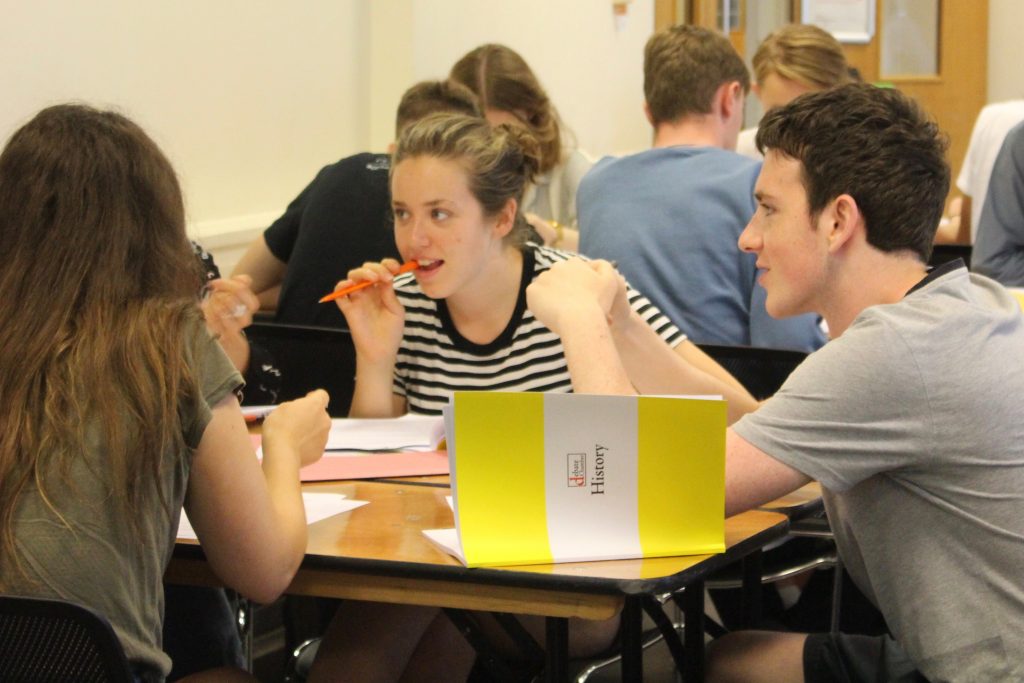
Teaching on the course is seminar-based and discussion-led. Rather than relying primarily on lectures, tutors guide small groups of students through close reading of texts, analysis of sources, and structured discussion of historical interpretations.
Students are encouraged to ask questions, test ideas, and respond to each other’s arguments. Tutors introduce key concepts and frameworks, but much of the intellectual energy of the sessions comes from exploring those ideas collaboratively.
Throughout the week, the emphasis is on careful thinking and open-ended enquiry rather than arriving at a single “correct” answer. The aim is to create an environment that reflects the way history is often studied at university: through conversation, debate, and shared investigation of complex questions.
Group sizes are kept deliberately small so that discussion can work properly and every student has the opportunity to contribute.
For the in-person courses, groups typically contain 12–16 students, depending on the room being used. For online courses, groups are usually 8–12 students, which allows discussions to remain focused and manageable in a virtual setting.
These sizes are large enough to allow a range of perspectives to emerge in conversation, but small enough that tutors can engage closely with each student and guide discussions in a thoughtful and supportive way.
Our tutors are selected for both their academic expertise and their ability to communicate complex ideas clearly and engagingly. Most have studied their subject to a very high level and many are currently undertaking postgraduate research at leading universities.
Equally important is their enthusiasm for teaching and discussion. Tutors are chosen not only for their subject knowledge, but for their ability to guide thoughtful conversations, challenge students’ assumptions, and create a collaborative and supportive classroom environment.
Because the groups are relatively small, students have the opportunity to get to know their tutors well over the course of the week and to discuss ideas with them in depth.
Click here to read more about some of the tutors who teach on our courses.
The atmosphere on the course is both warm and intellectually ambitious. Students are encouraged to challenge ideas, explore unfamiliar perspectives, and engage seriously with complex questions, but this always takes place within a supportive and collaborative environment.
Participants quickly discover that they are surrounded by other students who share a genuine enthusiasm for history. Discussions often become lively and energetic as students compare interpretations and build on each other’s ideas.
Tutors work carefully to create a space where students feel comfortable taking intellectual risks – trying out arguments, asking questions, and occasionally discovering that an idea does not quite work as expected. Those moments are often some of the most valuable parts of the learning process.
Many students find that the week develops a strong sense of shared curiosity, where participants support each other’s discoveries and celebrate new insights as they emerge.
Yes. Students receive a certificate of participation at the end of the week.
This simply confirms that they attended the course and took part in the programme. It is not connected to any formal qualification or external accreditation.
For most students, the main value of the course lies in the experience itself – the ideas explored, the discussions with tutors and other students, and the insights gained during the week.
Practical Details
The in-person course costs £845, and the online course costs £495.
Places can be reserved with a 25% deposit, with the remaining balance due eight weeks before the course start date.
We also offer a bursary scheme, which can support students with up to 90% of the course fees depending on circumstances. You can find full details on the bursaries page, or contact us if you would like to discuss your eligibility.
Both the online and in-person versions of the course run Monday to Friday.
For the in-person course, sessions run from 10:30 to 16:30, with a break for lunch at around 13:00.
For the online course, sessions run from 10:00 to 15:30, with short breaks during the day.
These schedules are designed to allow for focused academic work while still leaving students with time to rest and reflect between sessions.
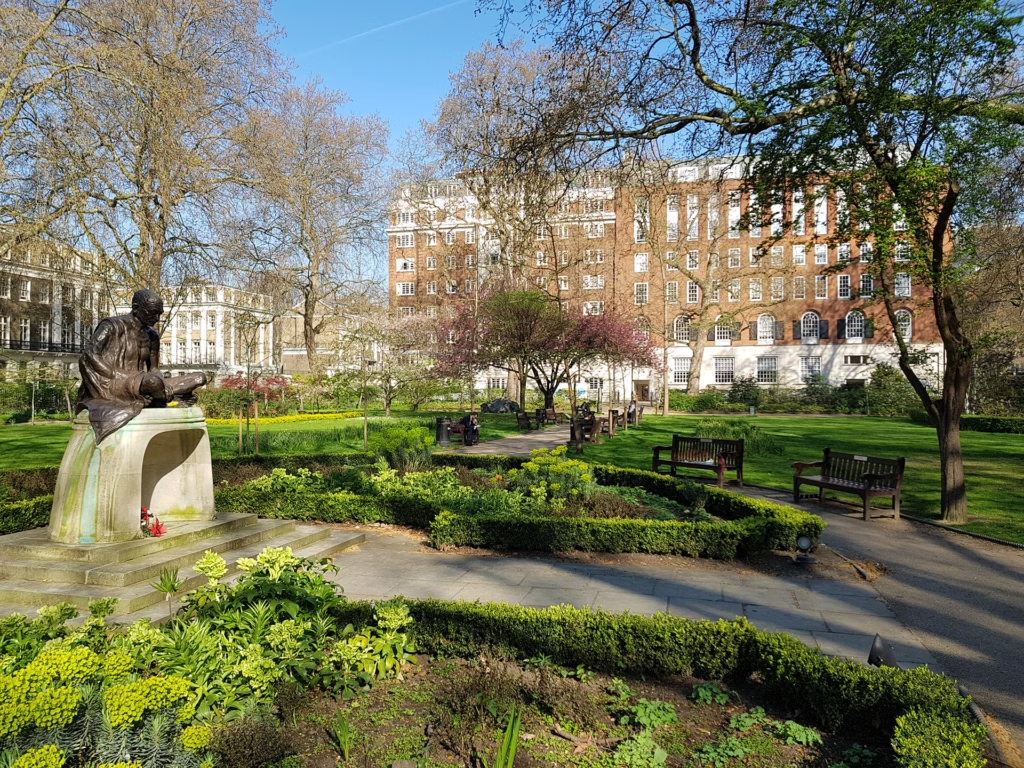
The in-person course takes place in Bloomsbury, in the heart of central London, an area well known for its concentration of universities, libraries, and cultural institutions.
It is a beautiful and historically rich part of the city, with many of London’s major academic institutions nearby and several of Bloomsbury’s famous garden squares just a short walk away – ideal for breaks and lunch between sessions.
The location is very easy to reach by public transport, with excellent Underground and rail connections.
You can find full details of the venue, along with travel information, on our How to Find Us page.
The academic content of the course is essentially the same in both formats. Students explore the same themes, take part in the same major simulations, and engage with the same kinds of historical texts and debates.
Some practical adjustments are made to ensure that discussions work well in an online environment. In particular, online groups are kept smaller so that students can get to know one another easily and conversations remain lively and manageable.
The overall intellectual experience is therefore very similar in both formats, with the main differences relating to the way discussions are organised and the practical structure of the day.
Yes. We actively welcome students from a wide range of social and educational backgrounds, and we believe that having a diversity of experiences in the classroom enriches the discussions for everyone involved.
For that reason, we offer a bursary scheme which can support students with up to 90% of the course fees, depending on circumstances.
Full details of how the bursary system works, including eligibility and how to apply, can be found on the bursaries page.
If you are unsure whether you might be eligible, or if you would like to discuss your situation before applying, you are very welcome to contact us. We are always happy to talk through the options and help families understand how the scheme works.
In most cases, yes. We are very happy to work with students who have particular access needs, whether related to physical disability, neurodivergence, or other learning requirements.
If there is anything that would help you participate more comfortably in the course, we encourage you to let us know in advance. The more information we have about a student’s needs, the easier it is for tutors and organisers to make appropriate adjustments.
Wherever possible, we will work with families to ensure that students can take part fully in the sessions and engage with the course in a way that suits their learning needs.
Still Curious About Studying History?
The History Summer School is an intensive five-day course designed to give students aged 15–18 a genuine experience of university-style history study. Through seminars, debates and historical simulations, students explore how historians interpret evidence and construct explanations about the past.
If you would like to explore the full course outline, including the teaching programme and application details, you can visit the History Summer School course page.